
How do we know when enough is enough?
How to rethink consumption while living within earth's physical limits.

When do we know we have enough of something?
Take food for example, most of us have a pretty reliable feedback mechanism that tells us when we have eaten enough, and we should stop. Or, think of a tank which overflows when full, so we stop filling it.
The problem is that we don’t have such simple, natural mechanisms to tell us when we have consumed enough of other things, outside our human bodies. How big a house is big enough? How many cars do we really need? How often do I really need a new phone? How many clothes is it reasonable to have? You get the picture.
We have to rely, perhaps, on our financial capacity to pay as the limiting factor, or our conscience. But when “success” in today’s world is often measured through external indicators of financial wealth, where is the incentive to say “STOP! I have enough.”?
The problem of overconsumption in Australia
Australia’s Earth Overshoot Day1 calculations give some insight into how much too much Australians consume. Earth Overshoot Day measures the relationship between the amount of resource humans consume in a year and the Earth’s ability to regenerate that capacity. According to this analysis, Australia used up its allocation of resources for the year on the 19th of March. We consume at the rate of 4.5 earths per year, putting us in the Top 15 consuming countries.
But we only have one earth with physical limits as to how much it can provide. When we consume faster than the earth can regenerate, systems become unbalanced and we start to experience the effects of climate change, biodiversity loss, water scarcity and land degradation.
We simply cannot keep consuming the way we do.
What concerns me is that, even with all that consumption, we aren’t generally improving wellbeing2, and we have a growing number of people falling through the cracks who do not have enough to meet their basic needs.
Exploring a new economic model - Doughnut Economics
That’s why I started learning about Doughnut Economics3. The “Doughnut” gives us a different way to think about our consumption, ensuring we can deliver the Social Foundation to ensure people have what they need while reminding us not to exceed the Ecological Ceiling of what the earth can actually provide. Doughnut Economics gives us a new lens to help shape our economic, social and environmental policies.
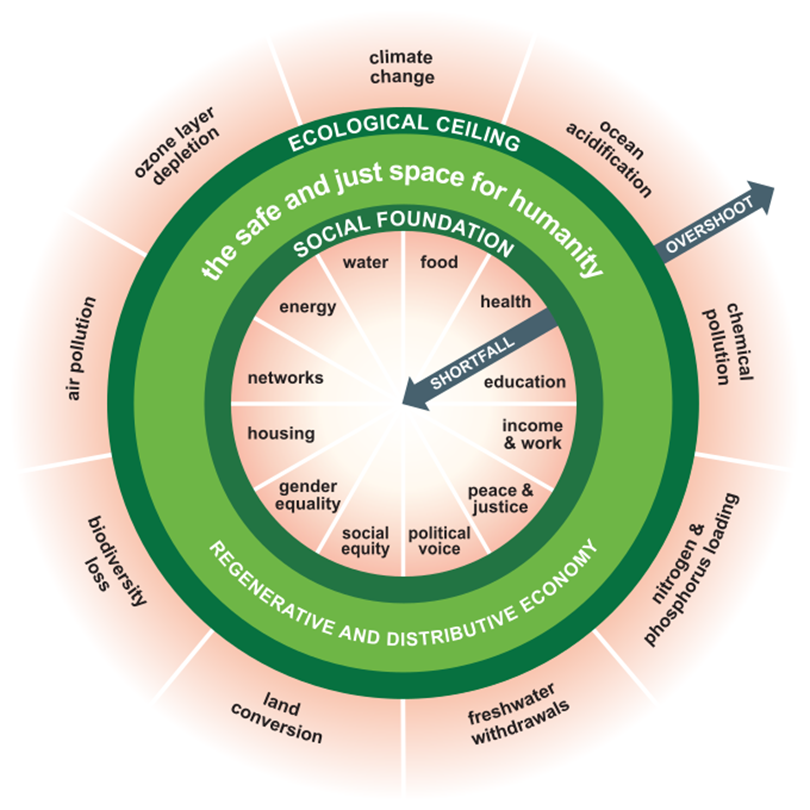
Source: What is the Doughnut? | DEAL
If we deliver on the Social Foundation, people will have enough money to meet their needs, people will have equitable access to quality health services, good education and meaningful work. Improved social connections and networks become a focus. We would likely experience less crime. By and large, we could expect less inequity and a probable increase in feelings of well-being and happiness.
At the same time, the “Doughnut” cleverly links the Ecological Ceiling to the Social Foundation in a way that few other economic models do. The earth is finite, so it makes no sense at all that our economic systems are built on infinite, year-on-year GDP growth. At some point, the earth will no longer be able to provide the resources to satisfy demand. The Doughnut references the nine planetary boundaries around the outside, and it is worth noting that recent assessments indicate that we are already operating outside “safe limits” in six out of the nine.
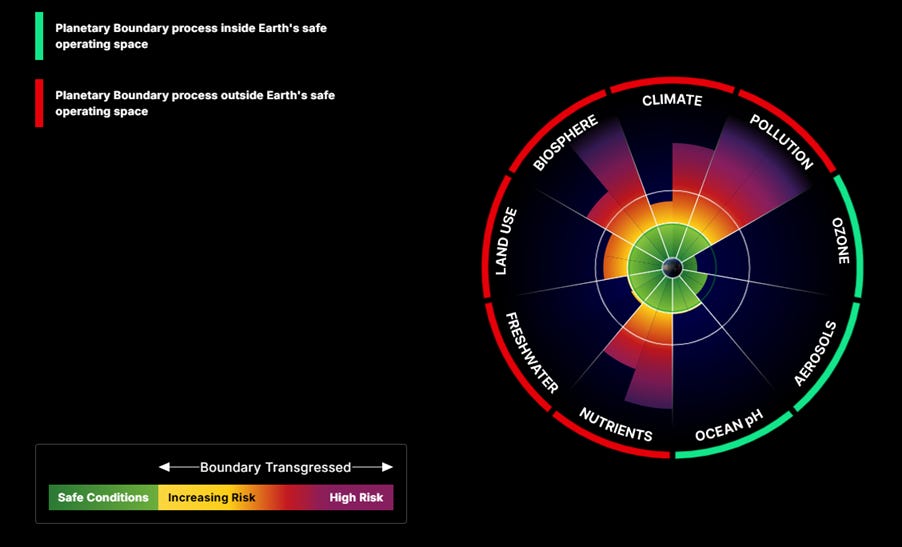
Source: Planetary Health Check 2024
And so?
I don’t believe that overconsumption naturally leads to a higher standard of living, general wellbeing or happiness. But it certainly does lead to environmental degradation at scale, some of which will be irreversible. For the sake of the planet, and for the well-being of humans in general, I’m hopeful that more people will learn about The Doughnut Economics approach. And in doing so, we will develop better measures of “success” and ways to tell ourselves and each other that, yes, in fact, we have enough.
Some of my favourite reading on how to tackle overconsumption includes:
- “The Art of Frugal Hedonism – a guide to spending less while enjoying everything more” by Annie Raser-Rowland
- “This One Wild and Precious Life” by Sarah Wilson, also on Substack
- “The More of Less” by Joshua Becker
References:
[Global Footprint Network 2025, www.overshootday.org and www.footprintnetwork.org. Country Overshoot Days 2025 - Earth Overshoot Day]
Research shows Australians are struggling | Australian Unity
Raworth, Kate (2017), “Doughnut Economics”
Doughnut Economics Action Lab
Thanks for this great reminder and links to the latest planetary boundaries science, I’ve struggled to find the most up to date references for that